Best Birthday Wishlist Apps and Websites: What to Look for Before Choosing One
Looking for a birthday wishlist app? Compare popular options and learn which features matter most for sharing gift ideas, coordinating guests, protecting privacy and avoiding duplicate presents.

LinGift Team
Editorial team
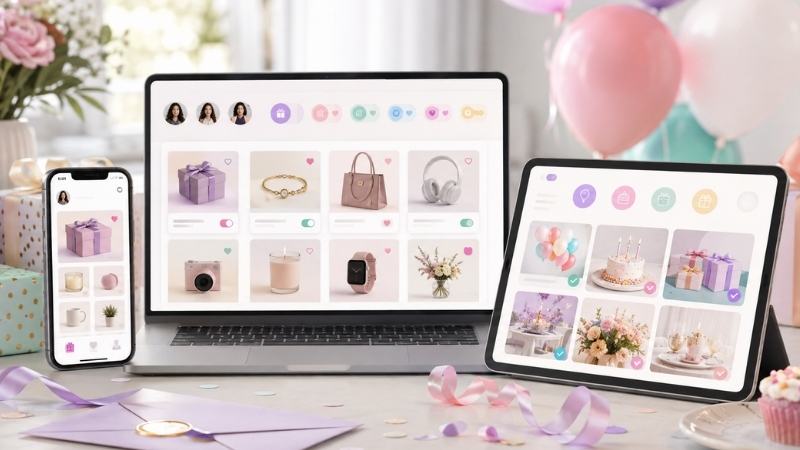
Creating a birthday wishlist online sounds simple: add a few gift ideas, share a link and let friends and family choose.
But once you start comparing wishlist apps and websites, the differences become much more important.
Some platforms focus on specific products from online stores. Others allow gift ideas from almost anywhere. Some are designed around family groups, while others prioritize privacy, gift reservations, registries or easy guest access.
And sometimes the most important feature has nothing to do with adding products at all.
You may need to share:
- Interests and hobbies.
- Favorite colors.
- Clothing or shoe sizes.
- Things the person already owns.
- Experiences instead of products.
- Things they would prefer not to receive.
- Specific gift suggestions.
- A way for guests to avoid choosing the same gift.
So rather than asking only:
“What is the best wishlist app?”
A more useful question is:
“Which wishlist works best for the way I want my birthday gifts to be organized?”
This guide explains what to evaluate and compares several popular approaches so you can choose the one that makes the most sense for your celebration.
What should a good birthday wishlist app do?
Before comparing platforms, start with the experience you want to create.
For most birthday celebrations, a useful wishlist should make things easier for two different people:
The organizer
The person creating the birthday list should be able to organize useful information without turning the process into a complicated project.
The guest
The guest should be able to open the list, understand what would make a good gift and make a decision without unnecessary friction.
A platform with dozens of features is not automatically better if your family finds it difficult to use.
For that reason, we recommend evaluating wishlist tools using the following criteria.
1. How easy is the list to share?
This should be one of the first things you check.
Most birthday invitations today are shared through:
- WhatsApp.
- Text messages.
- Email.
- Digital invitations.
- Social messaging.
- Printed invitations with QR codes.
A wishlist should ideally provide one simple link that can be included alongside the invitation.
Before choosing a platform, ask:
- Can I copy and share one link?
- Does it work well on mobile?
- Can the page be opened without installing an app?
- Can I include it in an invitation?
- Is a QR code available or easy to create?
Remember that the guest experience matters just as much as the organizer experience.
If opening the wishlist requires several steps, some guests may simply ask you what to buy instead.
2. Do guests need an account?
This can be surprisingly important.
You may be comfortable creating an account because you are organizing the event.
Your guests may not be.
Imagine sending a wishlist to a grandparent, another parent from school or a family friend who simply wants to select one birthday present.
If the first thing they see is:
Create your account to continue.
that additional step may be unnecessary friction.
Some platforms allow guests to view lists or even reserve gifts without creating an account. For example, Giftster states that visitors can shop a shared birthday list and mark gifts as reserved or purchased without creating their own Giftster account. GiftList similarly allows friends and family to view and reserve items without signing up.
This does not automatically make these platforms better, but guest access should be part of your decision.
3. Can you add gifts from different stores?
If your wishlist will contain specific products, check whether the platform limits you to one retailer.
A universal wishlist allows you to combine products from different websites into one list.
This might mean:
- An art kit from one store.
- A book from another.
- Sports equipment from a specialty retailer.
- Something handmade from a small online shop.
GiftList, Giftster, Elfster and MyRegistry all provide ways to add items from multiple stores or websites rather than limiting the user to one retailer.
This is particularly useful when you do not want your birthday wishlist tied to a single store.
4. Can you add ideas that aren't products?
This feature receives less attention than it deserves.
A good birthday suggestion might be:
Any adventure book suitable for ages 9–12.
Or:
A beginner art workshop.
Or simply:
She loves butterflies, animals and creative activities.
None of those necessarily needs a product URL.
For birthdays, the ability to add general ideas or preferences can sometimes be more useful than automatically importing a product.
Elfster allows custom wishes such as experiences or ideas without requiring them to be normal online products, while Things To Get Me allows list items to consist simply of a name, with links, images, prices and notes being optional.
Before choosing a platform, consider whether you want to create:
a shopping list
or
a source of gift inspiration.
They are not always the same thing.
5. Does it help prevent duplicate gifts?
For birthday celebrations with several guests, coordination becomes important.
Look for a feature usually called:
- Reserve.
- Claim.
- Mark as purchased.
- Taken.
- Selected.
The purpose is simple.
If one guest intends to buy a particular gift, another guest should be able to see that the idea is already being considered.
Giftster supports reserved and purchased statuses for guests. GiftList allows gifts to be reserved and keeps purchased gifts hidden from the list owner, while Things To Get Me allows visitors to reserve items from a shared list.
This can significantly reduce the chances of receiving two copies of the same item.
6. Can you preserve the surprise?
Avoiding duplicate gifts creates another challenge:
The guests need coordination, but the birthday person should not necessarily know what everyone is buying.
This matters especially when the person celebrating can access their own wishlist.
GiftList, for example, states that purchased gifts remain hidden from the list owner until they decide to reveal them.
Whatever platform you choose, test how gift reservations appear before sharing the list.
Ask yourself:
- Can guests see that an item is already selected?
- Can the birthday person see who selected it?
- Does the system reveal purchased gifts?
- Can that information remain hidden until after the birthday?
Good coordination should reduce duplicates without turning the wishlist into a preview of the presents.
7. What privacy controls are available?
A birthday wishlist may contain useful information about someone, so visibility matters.
Look for options such as:
- Private links.
- Unsearchable lists.
- Public lists.
- Family or group-only lists.
- Individual sharing controls.
Things To Get Me says its standard lists use unguessable links, cannot be found by searching someone's name and are requested not to appear in search engines.
GiftList provides public, private and friends-only visibility options, while Elfster offers public, limited and private wishlist settings.
There is no single privacy setting that is correct for everyone.
For a child's birthday, however, we would generally favor sharing only the information guests actually need.
8. Can you share preferences as well as products?
This is especially useful for children's birthdays.
Suppose a guest wants to buy clothing.
A product link alone may not be enough.
Useful information could include:
Clothing size 10–12. She prefers comfortable clothing in purple, pink, turquoise and pastel colors.
Or for books:
Adventure, fantasy and mystery books for ages 9–12. Please avoid horror themes.
Giftster, for example, provides a Gift Preferences section where users can share information such as clothing sizes, favorite colors, hobbies and interests. Elfster list descriptions can also contain likes, dislikes, colors, collections, allergies and similar information.
This type of context gives guests more flexibility when they want to choose something outside the exact products listed.
9. Is the wishlist designed for one event or for ongoing use?
Different tools follow different models.
Some are designed to maintain wishlists throughout the year.
Others work especially well for family groups.
Still others are built around a particular event.
Consider whether you need:
A permanent personal wishlist
Useful for birthdays, Christmas and other occasions throughout the year.
Family wishlists
Useful when family members regularly exchange gifts.
A celebration-specific list
Useful when preferences and gift ideas relate specifically to one birthday or event.
Neither approach is inherently better.
The best choice depends on how your family actually organizes gifts.
10. Does the platform work for the people you're inviting?
This may be the most important question of all.
A technically powerful wishlist can still be the wrong choice if the guests find it confusing.
Consider:
- Are most guests using phones?
- Are grandparents likely to open the list?
- Are guests comfortable creating accounts?
- Do some people prefer purchasing gifts in physical stores?
- Will guests need multiple languages?
- Do you want product links or simply gift guidance?
Recent community discussions about wishlist tools repeatedly mention practical concerns such as guest account requirements, mobile experience, adding products from different stores and allowing relatives to reserve gifts without complicated onboarding.
The best platform is not simply the one with the longest feature list.
It is the one your guests will actually use.
Popular birthday wishlist apps and websites to consider
There are many wishlist tools available, and no single platform is ideal for every family.
The following options represent several different approaches worth considering.
Features were reviewed in August 2026 and may change over time.
Giftster
May be a good fit for: families that exchange gifts regularly
Giftster is built strongly around family and close-friend groups.
Users can maintain wishlists, share them with their group and keep using the system for birthdays and other celebrations throughout the year.
One particularly useful birthday feature is the ability to share gift preferences such as:
- Clothing sizes.
- Favorite colors.
- Hobbies.
- Interests.
Giftster also allows products from online or offline stores to be added and lets guests reserve or mark gifts purchased without requiring their own account when using a shared public list.
Strengths
- Strong family-group model.
- Birthday reminders.
- Gift preferences in addition to products.
- Add items from different stores.
- Guest reservation without an account.
- Useful for repeated family gifting.
Things to consider
Its strongest value comes from its ongoing family-group structure. If you only need one lightweight birthday event and nothing else, you may not need the full family-oriented experience.
Consider Giftster if: your family wants to maintain wishlists for multiple people and occasions throughout the year.
GiftList
May be a good fit for: a modern universal wishlist with strong guest coordination
GiftList focuses on universal wishlists that can contain products from virtually any online retailer.
Its mobile app includes a built-in browser for adding products, and shared lists can be viewed without requiring guests to download the app or create an account.
Guests can reserve gifts, while purchased gifts can remain hidden from the list owner to preserve the surprise. GiftList also supports different visibility settings for lists.
Strengths
- Add products from different online stores.
- Mobile-focused experience.
- Guests can access lists without signing up.
- Gift reservations.
- Purchased gifts can remain hidden.
- Multiple privacy options.
Things to consider
The experience is strongly oriented around wishlist items and shopping. Families whose main priority is communicating broader context about a celebration may want to consider how much non-product information they need to share.
Consider GiftList if: adding products from multiple stores and making them easy for guests to reserve are your main priorities.
Things To Get Me
May be a good fit for: simple, private sharing with minimal account friction
Things To Get Me takes a comparatively lightweight approach.
Its birthday wishlist can be started without signing up, and standard lists use private links rather than being searchable by name.
Items can also be simple ideas: the only required information is a name. Product links, prices, images and notes are optional.
Guests who receive the link can reserve items.
Strengths
- No signup required to get started.
- Private, unsearchable list model.
- Reserve items through the shared list.
- Specific products are not required.
- Works with ideas, experiences and products.
- Apps and browser extensions are available.
Things to consider
The experience prioritizes simplicity over a highly structured social or family network. If you want profiles, family groups or a richer ongoing gifting ecosystem, another option may fit better.
Consider Things To Get Me if: you want a straightforward list that can be shared privately without making everyone join a platform.
Elfster
May be a good fit for: wishlists combined with gift exchanges and group gifting traditions
Elfster is widely associated with Secret Santa and gift exchanges, but its wishlist system can also be used year-round and for birthdays.
Users can create multiple lists, add products from different online stores and also write custom wishes for experiences or ideas that do not have a traditional product page.
Lists can have different visibility settings, and descriptions can include information such as favorite colors, likes, dislikes, collections or allergies.
Strengths
- Universal product adding.
- Multiple wishlists.
- Custom non-product wishes.
- Detailed wishlist descriptions.
- Privacy controls.
- Useful if the same group also organizes gift exchanges.
Things to consider
Elfster has a broader gift-exchange ecosystem, so families looking only for a simple birthday list may find themselves using only a portion of what the platform offers.
Consider Elfster if: your family or group already uses gift exchanges and you want wishlists inside the same ecosystem.
MyRegistry
May be a good fit for: people who want a universal registry rather than a casual wishlist
MyRegistry approaches the problem more from the gift registry side.
It allows users to bring together items from different stores into one universal registry and share them through a single link. It also supports features such as importing existing registries and cash or experience funds.
This can be particularly valuable when the exact items matter.
Strengths
- Universal registry across multiple retailers.
- One link for products from different stores.
- Import existing registries.
- Cash and experience funds.
- Appropriate for many types of occasions.
- Stronger traditional registry functionality.
Things to consider
For a casual child's birthday, this may offer more registry structure than some families actually need.
It may be a stronger fit when you want specific products, larger gifts or contributions, rather than mainly sharing interests and flexible ideas.
Consider MyRegistry if: your birthday list behaves more like a traditional registry and you want products from several retailers in one place.
LinGift
May be a good fit for: celebration-centered gift guidance
A disclosure before we continue:
LinGift is our own platform.
That gives us a commercial interest in it, so we believe it is important to evaluate it using the same questions we recommend using for other platforms rather than simply declaring it the best option.
LinGift takes a somewhat different approach from a traditional universal wishlist.
The starting point is the celebration, not the retailer.
An organizer creates an event and can share information that helps guests understand the person being celebrated, including:
- Gift preferences.
- Interests.
- Useful details.
- Things to avoid.
- Specific gift ideas.
The event can then be shared through a link or QR code, and gift ideas can be reserved to help coordinate guests.
Strengths
- Designed around the celebration.
- Combines preferences with specific gift ideas.
- Useful when guests need context, not only product links.
- Gift reservations help reduce duplicate selections.
- Shareable through a link or QR code.
- Works well when you want guests to retain freedom to choose something different.
Things to consider
LinGift is not currently intended to function as a large universal shopping aggregator.
If your primary goal is to automatically collect dozens of products from many retailers, compare prices or manage a traditional multi-store registry, a more established universal wishlist or registry platform may currently offer more specialized functionality.
LinGift is better suited to a different question:
“What information will help my guests choose a gift that is relevant to this person and this celebration?”
Consider LinGift if: preferences, context and celebration-specific gift coordination matter more to you than building a large product catalog.
So, which birthday wishlist app is best?
There isn't one answer for everyone.
Instead, match the platform to the problem.
If you want ongoing family wishlists
Consider Giftster.
Its family-group model and birthday reminders are particularly relevant for households that regularly exchange gifts.
If you want a universal product wishlist with strong mobile features
Consider GiftList.
It focuses heavily on adding products from different stores, sharing and reservation.
If you want a simple private list without much signup friction
Consider Things To Get Me.
Its lightweight private-link approach may be appealing for one-time or straightforward lists.
If your family also organizes Secret Santa or gift exchanges
Consider Elfster.
Wishlists sit within a broader gifting and exchange ecosystem.
If you want a traditional universal registry
Consider MyRegistry.
It is particularly useful when specific products, funds and multiple retailers are central to the list.
If you want to organize preferences around the celebration
Consider LinGift.
It may be a good fit when guests need to understand interests, preferences and gift ideas rather than simply shop from a collection of products.
A simple way to choose: start with these 7 questions
Before creating accounts on several platforms, answer these questions:
1. Do I want specific products or broader gift ideas?
If most of your list will be links to exact products, prioritize universal product support.
If preferences and inspiration matter more, look for flexible descriptions and custom ideas.
2. Do guests need to create an account?
Less friction can be particularly helpful for one-time birthday guests.
3. Can guests reserve gifts?
If avoiding duplicate presents matters, this should be high on your list.
4. Will the birthday person still be surprised?
Check what reservation and purchase information they can see.
5. How private is the page?
Understand whether it is searchable, public, group-only or accessible only through a shared link.
6. Will my guests actually use it?
Think about grandparents, classmates' parents, relatives and anyone else receiving the invitation.
7. Does it solve my actual problem?
This final question matters most.
Do not choose a platform because it has 30 features.
Choose it because it handles the three or four features your celebration really needs.
A practical example
Imagine Sofia is turning 10.
Her family wants guests to know:
Interests
Art, science, reading, crafts and games.
Favorite colors
Purple, pink, turquoise and pastels.
Useful details
Clothing size 10–12 and shoe size 35.
Specific ideas
- Art case.
- Science kit.
- Friendship bracelet kit.
- Adventure book.
- Board game.
Please avoid
Very loud toys and horror themes.
Now think about how different needs might change the platform choice.
If the parents want to provide exact links to products from many stores, a universal wishlist may be the priority.
If the extended family maintains lists year-round, a family-group platform may make more sense.
If they simply want to send one private link and let guests reserve ideas, a lightweight wishlist can be enough.
And if they want the gift ideas to sit alongside information about who Sofia is and what she currently enjoys, a celebration-centered approach may be preferable.
The best choice depends on the experience the family wants to create.
Don't overlook the guest experience
People creating wishlists naturally focus on how easy the platform is for them.
Try looking at it from the opposite side.
Imagine you receive a birthday invitation on your phone.
You tap the wishlist link.
Can you immediately understand:
- Who the celebration is for?
- What they enjoy?
- What gift ideas are available?
- Which ones are already reserved?
- Whether you can choose something different?
- What you need to do next?
If yes, the platform is doing its job.
If you need instructions explaining how to use the wishlist, it may be creating more work than it removes.
Frequently Asked Questions
What is the best birthday wishlist app?
There is no single best option for every family. The right platform depends on whether you prioritize universal product links, guest access, privacy, gift reservations, family groups or personal preferences.
What features should a birthday wishlist have?
For most birthdays, useful features include easy sharing, mobile access, guest-friendly viewing, privacy controls, enough flexibility for different gift types and a way to coordinate or reserve gifts.
Can guests use a wishlist without creating an account?
Some platforms allow this while others require different levels of account access. Check the guest experience before sending your invitations.
Can a birthday wishlist include items from different stores?
Yes. Universal wishlist platforms allow products from multiple retailers to appear in one shared list.
Can a birthday wishlist include ideas instead of products?
Yes, depending on the platform. General interests, experiences, handmade items and preferences can sometimes be more useful than exact product links.
How can a wishlist help prevent duplicate birthday gifts?
Look for reservation, claiming or purchased-item features. These allow guests to coordinate selections so multiple people are less likely to choose the same item.
Should a child's birthday wishlist be public?
It does not need to be. For children's celebrations, consider limiting the page to the information guests need and using a private or shared-link model when available.
Is a wishlist better than a gift registry?
It depends on your goal. A wishlist usually offers more inspiration and flexibility, while a registry can provide more structure around exact products. Some platforms combine elements of both.
Choose the experience, not just the app
The best birthday wishlist is not necessarily the platform with the most products, the most features or the biggest user base.
It is the one that makes the experience easier for the people involved.
For the organizer, that means less time answering:
“What should I buy?”
For the guest, it means enough information to choose with confidence.
And for the person celebrating, it means receiving gifts that have a better chance of being useful, relevant and genuinely enjoyed.
Before choosing a platform, think about what matters most:
Product selection?
Privacy?
Easy guest access?
Avoiding duplicates?
Personal preferences?
Family coordination?
Once you know that, choosing the right tool becomes much easier.
Looking for a celebration-centered option?
LinGift was created around the idea that a good gift often starts with better information, not simply a longer shopping list.
You can create a celebration, organize preferences and gift ideas, and share them with your guests through a simple link or QR code.
Guests can use the suggestions directly or use the shared preferences as inspiration when choosing something different.
Create your free LinGift account and organize the gift ideas for your next celebration.